
Comprehensive guide to troubleshooting and solutions
In the Balearic Islands, water is a precious resource and, let’s be honest, it’s becoming increasingly expensive. If you feel that the water level in your swimming pool is dropping faster than usual, you’re not just wasting money on your water bill; you’re also wasting chemicals and putting the structure of your terrace or garden at risk.
Here at JMCifre, we have put together this technical guide to help you distinguish between natural evaporation during the Mallorcan summer and a genuine fault requiring professional intervention.
Evaporation or a water leak?
Before you start worrying, remember that in Mallorca (and the other Balearic Islands), due to the high temperatures and dry winds, it is normal for a swimming pool to lose between 4 and 7 mm of water a day.
If the loss exceeds 2 cm a week, it’s time to take action. But how can you be 100 per cent sure without calling a technician just yet?
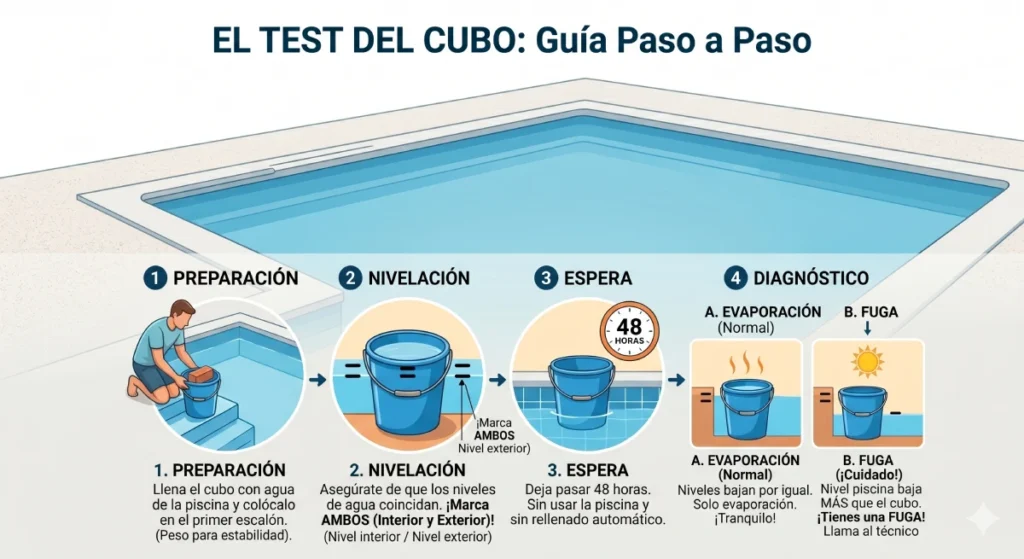
The ‘Cube Test’: The most reliable home method
This test is foolproof for ruling out the influence of the sun and the wind:
Instructions: Fill a bucket with water and place it on the first step of the swimming pool.
Levelling: Make sure that the water level inside the bucket matches the pool’s water level outside exactly. Mark both levels with tape or a permanent marker.
Please wait: Leave the pool unused for 48 hours and ensure the automatic refill system is not running.
Diagnosis: If the water level in the pool has dropped more than that in the bucket, you have a leak. If they have both dropped by the same amount, it is simply evaporation.
The 5 warning signs you mustn’t ignore to spot a water leak in your swimming pool in Mallorca
Sometimes a leak isn’t obvious, but your pool will give you clues. Look out for these signs:
Air in the return nozzles: If you see air bubbles coming out of the impellers, this is a sign that there is a crack in the suction circuit which is ‘sucking in’ air.
Persistent damp in the ground: If you notice areas of the garden that are always damp, or paving slabs around the perimeter that are starting to lift or sink.
Cracks in the glass or loose mosaic tiles: Small hairline cracks may seem harmless, but under the pressure of thousands of litres, they act as proper drains.
Constant pH imbalance: If you’re finding it incredibly difficult to maintain the pH and chlorine levels, it may be because the water is constantly being replaced due to a leak and the automatic top-up system.
Engine losing suction: If the pool pump is running dry or is struggling to start, the leak may be in the pipes running from the skimmer to the plant room.
Advanced Diagnostics: Where exactly is the problem?
Once you’ve confirmed there’s a leak, the next step is to narrow down the area. You can carry out this brief technical ‘triage’:
Engine test (On vs. Off)
If you lose more fluid whilst the engine is running: The leak is usually in the pressure pipes (where there is pressure).
If you lose more water when the pump is switched off: The problem is usually with the bowl (cracks) or the intake pipes/skimmers.
The stop-level test
Let the water run until it stops of its own accord.
If it stops right at the mouth of the skimmer, that’s where the break is.
If water is seeping down to the light fittings, it is likely that the cable gland on the light fitting is not properly sealed. This is one of the most common problems in Mallorca.
JMCifre technology: Detection without causing any damage
In the past, detecting a leak meant tearing up the entire terrace. Today, at JMCifre we use non-invasive technology to pinpoint the exact location with millimetre precision:
Geophones (Acoustic Monitoring): We amplify the sound of water leaking underground. Each leak has a distinctive ‘sound’ that our technicians are able to identify.
Tracer Gas (Nitrogen-Hydrogen): We inject this harmless gas into the pipes. As it is the smallest molecule, it escapes through the crack and rises to the surface, where our sensors detect it. It is the most accurate method for detecting invisible leaks.
CCTV Inspection: We insert flexible cameras into the pipes to identify structural damage or roots that have penetrated the system.
Frequently asked questions about water leaks in swimming pools in Mallorca
Is it very expensive to locate a leak?
It is much more expensive not to locate it. A small leak can waste 500 litres a day. The cost of locating the leak is quickly recouped by avoiding unnecessary building work and saving on your water bill.
Can a leak be repaired without draining the pool?
In many cases, yes. We use underwater resins and polymers to seal cracks or expansion joints without having to drain the thousands of litres of water that are so difficult to replenish on the islands.
What happens if I ignore the leak?
Any water that leaks out can wash away the ground beneath the swimming pool, creating hollows that may eventually lead to structural damage to the pool itself, the repair of which can be up to 10 times more expensive.
Is your swimming pool losing water? Take action before it gets any worse.
At JMCifre Piscinas, we specialise in the technical detection and repair of leaks throughout Mallorca. Protect your investment and enjoy a worry-free swim.