
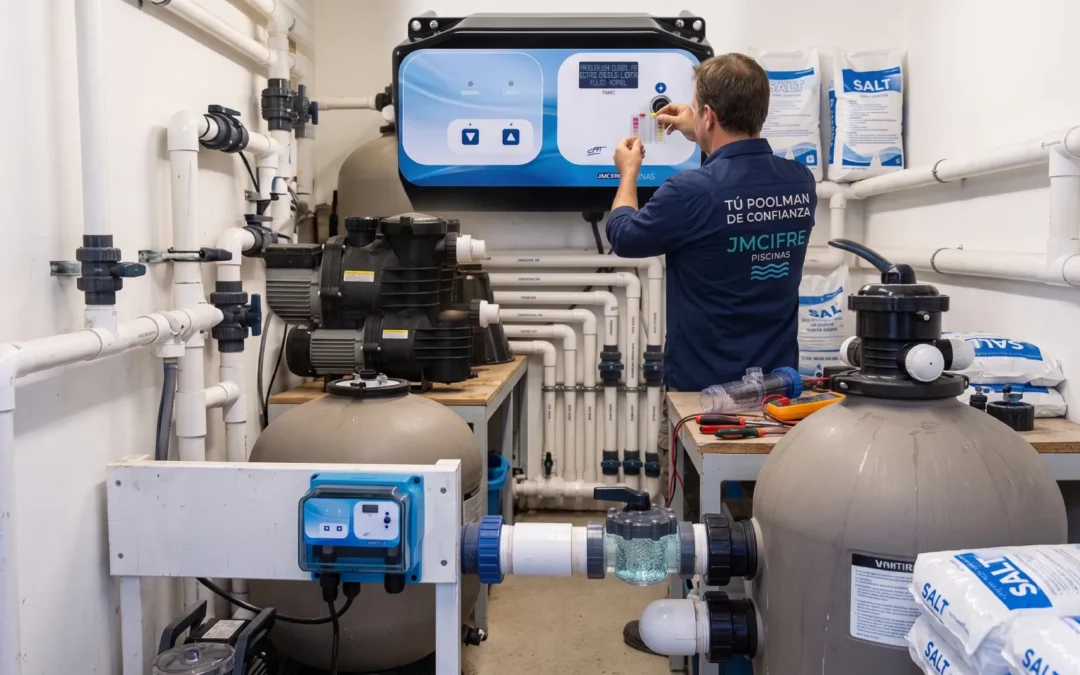
A salt chlorinator is an investment designed to free you from the chemical maintenance of your pool… until it starts to fail.
When that happens, many owners don’t know if the problem is the cell, the control unit, or simply a salinity adjustment, and end up treating the water blindly while the problem persists.
In this guide we review how to identify a fault in your salt chlorinator, the most frequent causes and when it is worth repairing it rather than replacing it.
How to tell if your salt chlorinator is broken?
Before considering a repair, it’s worth ruling out the simplest possibilities: often what appears to be a breakdown is just a minor issue. This checklist will help you distinguish between the two in five minutes.
Check these 5 points
1. Salt level. Check that it is within the range indicated by the manufacturer (usually 3,000-6,000 ppm). A low level reduces chlorine production without any actual malfunction.
2. Water temperature. Below 15-18°C, many chlorinators automatically reduce or stop production — this is normal equipment behavior, not a malfunction.
3. Display status. An error code or flashing light indicates a fault that requires inspection. If the display is off, check the power supply first.
4. Cell appearance. If upon inspection you see the plates covered with a thick white or gray layer, it is calcification — it is solved by cleaning, not necessarily by replacement.
5. Daily filtration time. If the filtration system is not running long enough, the chlorinator will not have a chance to produce an adequate amount of chlorine, even if it is in perfect working order.
If you recognize any of these symptoms, it is usually not necessary to replace the entire unit: most faults are in a specific component.
Most common causes of breakdown
Wear or calcification of the electrolysis plates. This is the most common problem. The plates produce chlorine from salt, and over time (or with very hard water) they accumulate limescale, which reduces their efficiency until they stop producing chlorine altogether.
Fault in the control unit or electronic board. Less frequent, but when it occurs, it usually displays a specific error code. It requires technical diagnosis, as sometimes the problem is a fuse or a connection, not the entire board.
The salinity sensor is out of calibration. If the system does not accurately detect the salt level, it may reduce chlorine production as a safety measure, even if the water is at the correct levels.
Wiring or connections damaged by moisture. Common in older installations, especially if the machine room is not well ventilated.
Repair the cell or replace it?
The cell (the set of plates) has an average lifespan of 3 to 5 years depending on usage and water quality. For reference:
Mild-moderate calcification: can be cleaned with a diluted acid solution and recover much of the performance — it is the most economical repair.
Worn or physically damaged circuit boards: they cannot be recovered by cleaning; the cell must be replaced, but not the entire unit.
Control unit over 8 years old with electronic failure: in this case, depending on the cost of the diagnosis, it may be more worthwhile to consider a new unit than to repair the electronic board.
Preventive maintenance to avoid breakdowns
An annual service of your salt chlorinator, ideally at the start of the season, allows you to detect limescale or wear before it leads to a breakdown that leaves you without chlorine in the middle of summer. This includes cleaning the circuit boards, checking the salinity sensor, and inspecting the connections.

Frequently Asked Questions
How long does a salt chlorinator cell last?
On average, between 3 and 5 years, depending on usage, water quality, and whether it receives regular cleaning.
Can I clean the chlorinator cell myself?
Basic cleaning with water and a diluted acid solution is simple, but if there is significant limescale buildup or you have any doubts about the scale, it’s best to have it checked by a professional to avoid damaging it.
Why isn’t my salt chlorinator increasing the chlorine level even though it’s turned on?
This could be due to limescale buildup, a miscalibrated salinity sensor, or a problem with the control unit. A diagnostic test is the quickest way to determine the actual cause.
Is a salt chlorinator better than traditional chlorine?
It depends on your maintenance priorities and budget. If you’d like a more in-depth comparison, you can read our article on salt chlorination versus chlorine in swimming pools in Mallorca.
Is your salt chlorinator not working properly? At JM Cifre Piscinas, we diagnose and repair salt chlorinator malfunctions in Mallorca.